After arriving back from 3 weeks away with much excitement I celebrated my 1 year on the road anniversary (if I can still call it being 'on the road') with a walk along the Great Wall of China with Cecily, an experience that is among the few to manage to live up to my expectations and an incredible way to mark the 366th day since I cycled away from home in Eastbourne!
Que more lazy days in coffee shops and quandaries about what to do from day 389 onwards...
In the meantime, I survived an evening out in the firework-and-debris strewn Beijing streets, when regulation and sense are left behind for the last legal opportunity to set off fireworks in the city. The Lantern Festival falls on the first full moon of the new lunar year and marks the end of China's, and much of Asia's, mammoth 15-day New Year festivities.
Close your eyes and you could be in a war zone. Open them and you still could be.
The firework displays I'm used to involve a couple of trained pyrotechnicians in a 200-metre exclusion zone. These are boring. My new favourite firework displays involve a guy who had 150 yuan in his pocket and a cigarette (the firework lighter of choice). Plonk the jumbo box down in the middle of the road without fanfare, light the fuse (is it lit? maybe? better check...) and retreat to the safe distance of 3 or 4 feet. People nearby? They'll be gone once the first one explodes. Part fear, part awe, everyone then stands for the next 60 seconds and watches the fireworks explode into the neighbouring buildings, sparks returning to earth unextinguished, stray non-vertical eruptions threatening us all but, in a Russian Roulette kind of way, that is part of the fun. And it was fun; I couldn't stop laughing with excitement the first time I saw it on my way to the shops. Whaaaaat?! It's a great example of the lack of rules and regulations, but the aftermath is all you need to realise why the rules and regulations exist. Every year at this time those that forget to close their windows find their apartments gutted - this year's toll: 194 fires (in Beijing), 388 injuries (in the first 6 days), 40 deaths (nationally), and 5,945 fires nationwide in 32 hours.
Cecily is currently visiting one of 'the world's most polluted places' for her work so I have finally managed to leave Beijing behind for a few days in Xi'an, the city at the end of the Silk Road and home to the Terracotta Warriors. Shrouded in the eponymous Chinese haze that has been noticeably absent for most of my time in Beijing, Xi'an is crowded and polluted and historically significant, an ancient capital and political, economic and cultural centre of China.
I'll have to post a mammoth photo update of the Great Wall and the Warriors once I'm free of the bounds of China's internet control, which will come with my visa expiring on March 9th, as, like the Great Wall, describing them in words is a pointless exercise.
Thursday, 24 February 2011


Sunday, 13 February 2011
Korea: Busan, Gwangju, Seoul
From Tokyo I caught the awesome-looking but average-velocity shinkansen Bullet Train over 1000km south to Hakata/Fukuoka (the 5 hour journey would have been impressive if the Chinese equivalent I took a few weeks before wasn't 25mph faster and a lot less than £160, but it did have wifi and lots of leg room). After 1 night there which involved forcibly getting drunk on shochu and sake at the behest of 2 epitomical Japanese businessmen, I took a ferry across to Korea.
The visit to Korea for me focused on the capital, Seoul, thanks to the incredibly catchy advertisement that has been in my head for months since I started watching CNN on hotel room TVs, and a stop-off in Gwangju to visit Chris who I originally met in Delhi and bumped into again in Bangkok, and is now in Korea on behalf of a female (small world for sure, in more ways than one). More time was spent playing pool or asleep and/or hungover in Gwangju than I would like to admit so aside from having the company of Haena who is Korean, my insights only went as deep as the realisation that the young folk here are incredibly attractive and incredibly fashionable, with their lens-less black rimmed glasses and crazy hairstyles.
Seoul is a massively popular city with a huge number of Brits, Americans, Canadians and Australians there to teach English, and along with the fact it's pretty inexpensive, safe and has a lot going on, not to mention that the Korean girls seem to find something remarkable about Western guys (whether that is for better or worse; the continual giggling may have been genuine hilarity, or maybe it was just my beard), makes it a fun place to be.
With the long bus ride there and a flight booked to coincide with Cecily's return to Beijing from her hometown for Chinese New Year, I only had a couple of days to explore the city and brave the cold, but they were pretty full and took in a couple of palaces complete with changing of the guards ceremonies as they happened centuries ago under King Sejong the Great and generally getting a feel for Seoul's particular 'vibe', which even in the cold and quiet of the New Year celebrations exists along the pretty riverside in the centre of the city, and the bustling shopping and nightlife districts around Hongik University and Myeong-dong.
Most affecting though was a chance visit to an exhibition entitled 'Where Love Does Not Exist', displaying and describing life within North Korea's Prison Camps which, in my ignorance, I didn't realise existed. Thanks to the media and Team America I saw Kim Jong-il as a deluded but funny character to make fun of until he dies, but with stories of imprisonment in 'Complete Control Districts' and treatment reminiscent of Nazi Germany, I will think again. The most shocking story for me, in amongst many both tragic and graphic, was about the North Korean Cheerleading Team (I know that sounds like an oxymoron) - 21 girls sent to the South for the Asian Games in 2002 and imprisoned on their return for 'breaching their pledge not to divulge anything they have seen or heard during their trip'. It appears they are still imprisoned in Taehŭng concentration camp for political dissidents where, if all is to be believed, they are treated incredibly badly, however with the controls the North has on such issues the only sources available are dissidents who have escaped.
So then I had coffee and read some Dickens.
That lead to another experience of hospitality and kindness to strangers reminiscent of Iran, as I was accompanied on my trip to the N Seoul Tower by new friend and Doctor of Oriental Medicine, Subeom. It was dark and misty so the view wasn't spectacular, but from 500m up (the tower is on top of a small mountain) the extent of the city on the Han River was impressive.
Seoul is a friendly city and Korea is an interesting country with an interesting history, ancient and modern, sitting somewhere in between Japan and China not only geographically but also socially, with people looking both ways and drawing on both modern cultures, however I couldn't quite place it or get a full perspective of it, whether because it is hidden beneath the mixed culture or the Korean culture just has blurred lines between it and its neighbours, or maybe I just wasn't there long enough.
Back in Beijing now for the remnants of the New Year celebrations (i.e. avoiding death-by-firework) before paying a visit to some other parts of China. As usual, photo posting is not working so will follow sometime.
The visit to Korea for me focused on the capital, Seoul, thanks to the incredibly catchy advertisement that has been in my head for months since I started watching CNN on hotel room TVs, and a stop-off in Gwangju to visit Chris who I originally met in Delhi and bumped into again in Bangkok, and is now in Korea on behalf of a female (small world for sure, in more ways than one). More time was spent playing pool or asleep and/or hungover in Gwangju than I would like to admit so aside from having the company of Haena who is Korean, my insights only went as deep as the realisation that the young folk here are incredibly attractive and incredibly fashionable, with their lens-less black rimmed glasses and crazy hairstyles.
Seoul is a massively popular city with a huge number of Brits, Americans, Canadians and Australians there to teach English, and along with the fact it's pretty inexpensive, safe and has a lot going on, not to mention that the Korean girls seem to find something remarkable about Western guys (whether that is for better or worse; the continual giggling may have been genuine hilarity, or maybe it was just my beard), makes it a fun place to be.
With the long bus ride there and a flight booked to coincide with Cecily's return to Beijing from her hometown for Chinese New Year, I only had a couple of days to explore the city and brave the cold, but they were pretty full and took in a couple of palaces complete with changing of the guards ceremonies as they happened centuries ago under King Sejong the Great and generally getting a feel for Seoul's particular 'vibe', which even in the cold and quiet of the New Year celebrations exists along the pretty riverside in the centre of the city, and the bustling shopping and nightlife districts around Hongik University and Myeong-dong.
Most affecting though was a chance visit to an exhibition entitled 'Where Love Does Not Exist', displaying and describing life within North Korea's Prison Camps which, in my ignorance, I didn't realise existed. Thanks to the media and Team America I saw Kim Jong-il as a deluded but funny character to make fun of until he dies, but with stories of imprisonment in 'Complete Control Districts' and treatment reminiscent of Nazi Germany, I will think again. The most shocking story for me, in amongst many both tragic and graphic, was about the North Korean Cheerleading Team (I know that sounds like an oxymoron) - 21 girls sent to the South for the Asian Games in 2002 and imprisoned on their return for 'breaching their pledge not to divulge anything they have seen or heard during their trip'. It appears they are still imprisoned in Taehŭng concentration camp for political dissidents where, if all is to be believed, they are treated incredibly badly, however with the controls the North has on such issues the only sources available are dissidents who have escaped.
"I was born in a political prison camp and lived for 24 years without knowing who Il-Sung-Kim and Jong-Il-Kim were. I have never heard the words 'love', 'happiness', 'contentment', 'unfortunate', 'injustice', 'resistance', and only discovered the meanings of these words in South Korea. These words are words that do not exist in political prison camps. Socialised with the bare minimum of words and emotions to perform addition and subtraction, and to follow work instructions, we were bred under physical violence as labouring slaves."
-Former prisoner of the 14th Gaechon Completely Control Zone Camp from Dong-Hyuk Shin's memoir.
Other stories included inmates having to eat rats and snakes just to survive,and punishment for breaking any of the prison rules being death.
Other stories included inmates having to eat rats and snakes just to survive,and punishment for breaking any of the prison rules being death.
So then I had coffee and read some Dickens.
That lead to another experience of hospitality and kindness to strangers reminiscent of Iran, as I was accompanied on my trip to the N Seoul Tower by new friend and Doctor of Oriental Medicine, Subeom. It was dark and misty so the view wasn't spectacular, but from 500m up (the tower is on top of a small mountain) the extent of the city on the Han River was impressive.
Seoul is a friendly city and Korea is an interesting country with an interesting history, ancient and modern, sitting somewhere in between Japan and China not only geographically but also socially, with people looking both ways and drawing on both modern cultures, however I couldn't quite place it or get a full perspective of it, whether because it is hidden beneath the mixed culture or the Korean culture just has blurred lines between it and its neighbours, or maybe I just wasn't there long enough.
Back in Beijing now for the remnants of the New Year celebrations (i.e. avoiding death-by-firework) before paying a visit to some other parts of China. As usual, photo posting is not working so will follow sometime.
Monday, 7 February 2011
Photos from Tokyo
 Shibuya Crossing, one of if not the busiest crossing in the world, overlooked by one of the busiest Starbucks in the world. This is also the location of Shibuya station where Hachikō the dog (star of the movie with Richard Gere) waited for his owner at the same time everyday for 9 years following his death.
 Having seen other photos of the crossing, this Sunday evening was apparently a quiet time.
 Even so the crossing reloads with people with each-and-every phase of lights.
Tokyo is also home to the world's busiest station in Shinjuku, with an average of over 3.6 million passengers per day, which along with over 200 exits makes getting anywhere fast pretty tricky for the inexperienced.
 The view over huge, sprawling Tokyo and across to the mountains from the Tokyo Metropolitan Government Building in Shinjuku.
 And that is Mt. Fuji, which you can see in the wide shot above under the cloud in the left third.
 A more peaceful side of Tokyo in Asakusa, the ancient Downtown entertainment district.
 The 634m 'Sky Tree', atop which are 2 crane operators who deserve a lot of money.
 The rather strange bouffant-and-pointy-shoe look of the 'hosts' in Tokyo's Kabukichō red-light district - these guys all stand out on the street to 'catch' female customers, and who wouldn't be tempted? From Wikipedia; "a night of non-sexual entertainment could cost $500 to $600. A women's studies professor explained the phenomenon by Japanese men's lack of true listening to the problems of women, and by women's desire to take care of a man and be loved back".
Thursday, 3 February 2011
Tokyo, and Thoughts on Japan
Cecily summed Japan up better than I could hope to in her comment on my last post: (ignoring the part about watching US sitcoms, I don't know what she's talking about there as I am clearly a committed cultural explorer) "It shows the mixed culture of Japan: adopted modern culture, well-preserved tradition, bustle and peaceful. Mysterious as it is always. It is Japan".
I think most people's thoughts on Japan include the hyper bustling megatropolis of Tokyo (most likely the iconic view of Shibuya crossing) alongside a peaceful Zen Buddhist temple. Both views are correct and in reality not always that separate.
There's a distinct similarity between the Japanese cities I visited and I think that extends throughout the country - on any brief stroll you can see women in traditional dress alongside girls in decency-defying modern outfits, 6th Century Shinto shrines enveloped and overlooked by 21st Century business buildings, neon alongside lanterns and cyclists alongside supercars, and packed pachinko (pinball) parlours and seedy host/ess clubs alongside... well, there is no ancient mirror for that, I suppose they are a modern extension of an evening of entertainment with mahjong and a Geisha. Wherever you are, walking 1 street away from the well-trodden paths of tourists and locals alike can see you in a peaceful street of traditional homes lived in my stooped old men and women for generations.
As for the people themselves, as contradictory and fascinating as a modern Western people can get to a modern Westerner - the surface is placid, with a thick layer of incredible politeness and sensitivity to feeling and ego, respect and reverence for other people permeating all aspects of daily life. The conductors and food-trolley stewardesses bow on entering and exiting train carriages, all members of staff welcome each-and-every customer to walk through the door of any restaurant, shop or bank, friends young and old part with multiple bows, and all talking seems to be littered with excuse mes and thank yous. The subway is silent; everyone is using their mobile phone to text or browse but no one is talking or letting it ring aloud, and there are no audible conversations. More people seem to be asleep than usual, which I suppose hints at the long hours spent working and studying - 'Salarymen' working 12 hours a day and clinging onto a job following the economic bubble-bursting of the early '90s. This along with the unique way of interacting it seems has lead to the culture of men and women paying £30 to sit with a member of the opposite sex for nothing more x-rated than a chat - every red light area is packed with these and they seem to be patronised fairly regularly. Add to these the 'Maid Cafes' and Chikan (pervert) Bars: mocked-up train carriages where you can grope the 'sexy commuters', acting out what is a big problem on Japanese trains at rush hour - and the more underground, social repression-enforced quirks and perversions begin to appear below that placid surface.
Photos from Tokyo and words from Korea to follow, as it's late and beer awaits.
I think most people's thoughts on Japan include the hyper bustling megatropolis of Tokyo (most likely the iconic view of Shibuya crossing) alongside a peaceful Zen Buddhist temple. Both views are correct and in reality not always that separate.
There's a distinct similarity between the Japanese cities I visited and I think that extends throughout the country - on any brief stroll you can see women in traditional dress alongside girls in decency-defying modern outfits, 6th Century Shinto shrines enveloped and overlooked by 21st Century business buildings, neon alongside lanterns and cyclists alongside supercars, and packed pachinko (pinball) parlours and seedy host/ess clubs alongside... well, there is no ancient mirror for that, I suppose they are a modern extension of an evening of entertainment with mahjong and a Geisha. Wherever you are, walking 1 street away from the well-trodden paths of tourists and locals alike can see you in a peaceful street of traditional homes lived in my stooped old men and women for generations.
As for the people themselves, as contradictory and fascinating as a modern Western people can get to a modern Westerner - the surface is placid, with a thick layer of incredible politeness and sensitivity to feeling and ego, respect and reverence for other people permeating all aspects of daily life. The conductors and food-trolley stewardesses bow on entering and exiting train carriages, all members of staff welcome each-and-every customer to walk through the door of any restaurant, shop or bank, friends young and old part with multiple bows, and all talking seems to be littered with excuse mes and thank yous. The subway is silent; everyone is using their mobile phone to text or browse but no one is talking or letting it ring aloud, and there are no audible conversations. More people seem to be asleep than usual, which I suppose hints at the long hours spent working and studying - 'Salarymen' working 12 hours a day and clinging onto a job following the economic bubble-bursting of the early '90s. This along with the unique way of interacting it seems has lead to the culture of men and women paying £30 to sit with a member of the opposite sex for nothing more x-rated than a chat - every red light area is packed with these and they seem to be patronised fairly regularly. Add to these the 'Maid Cafes' and Chikan (pervert) Bars: mocked-up train carriages where you can grope the 'sexy commuters', acting out what is a big problem on Japanese trains at rush hour - and the more underground, social repression-enforced quirks and perversions begin to appear below that placid surface.
Photos from Tokyo and words from Korea to follow, as it's late and beer awaits.
Saturday, 29 January 2011
Osaka, Nara and Kyoto
 Osaka: 'America Village' topped by the Statue of Liberty, a weird corruption of the US fashion world beloved by Japanese youth and a great place to people watch. Dotombori, middle and left, bustling shopping arcades on canals with the kind of girls wearing the kind of clothes that leave you with eye and neck strain.
 "Is Buddhism for me?" A wild deer of Nara, the original Japanese capital, visits one of the many temples.
 Todai-ji temple in Nara-koen, a hugely impressive temple with a huge and impressive Buddha even for someone who has seen a lot of temples and Buddhas. Apparently the biggest wooden building and the biggest bronze Buddha in the world.
 The very tame but still wild deer of Nara are all over the city, hassling children for crackers and knocking over the elderly.
 Water for purification at the entrance to all Buddhist temples.
 Kyoto: A geisha, whether genuine or model, in the ancient geisha district of Gion. There are fewer than 100 in the city and 1000 in Japan.
 The cobbled streets of Higashiyama, in Kyoto, are lined with original wooden latticed Japanese homes and restaurants and walked by women in kimonos and wooden sandals, the only giveaway of the current year being the cables and the cameras.
 Kyoto: Japanese lanterns and characters are now noticeably different from their Chinese cousins.
 Kyoto: A bamboo forest in the hills above the city. I walked through a deserted temple and up here for a great view across the city to the mountains opposite, surrounded by family shrines and undisturbed by the people below.
 Trinkets left at the shrines above the city.
 The Ryōzen Kannon memorial in Kyoto commemorating the Japanese soldiers who died during WWII, seen through a metal grate as it was closed.
 Sun setting over Kyoto with the silhouette of the Kyoto Tower on the left, my landmark for finding my way back to the hostel without a map after a long day of exploring.
Sunday, 23 January 2011
65 Hours to Japan
 The Yan Jing, my home for just over 2 days
I'm now saying konichi wa with a bow instead of ni hao with a handshake, and domo arigato instead of xie xie. From back home I would have put Japan and China firmly in the same box, my knowledge of the 2 contrasting countries having been about the same as the 6 year old me stood in the local fish and chip shop chanting 'Chinese Japanese' whilst pulling the corners of my eyes up and down in front of the stainless steel counter. The 6 year old me I will forgive but the 23 year old has been very much enlightened.
But to begin from the beginning... How hard it was to leave that nice warm bed and that beautiful warm person at 4:50 on Tuesday morning. I don't think it needs to be emphasised how much I've enjoyed this chance stay in Beijing, and that the only reason for my departure is my visa's imminent expiration. The journey began with a taxi, and then a 210mph train ride to the coastal city of Tianjin, followed by a 2 hour taxi ride to the port which included a lot of shouting and confusion and my first realisation of how much I've been sheltered from the inconvenience of unshared language for my time in China. With the childish drawing of a ship on the ocean I finally arrived at the terminal to board the ship that would be taking me across the Yellow Sea to Japan.
I was the 1 and only laowai (old foreigner) or gaijin (outside person) and the only solo traveler aboard a ship of 200 mainly Chinese and a few Japanese, mostly young people making the journey for work. What with my mood at having left Cecily and my temporary home behind and the attention caused by this, the first few hours were spent quite uncomfortably, not to mention dealing with the unappealing thought of being stuck aboard this ship for more than 2 days. A few fellow passengers found the courage to approach what was probably a pretty unwelcoming face hidden in a book, but when they did the typical warmth and friendly curiosity was hard not to warm to. I was given Chinese tea (drunk by almost everyone traveling, usually in a clear bottle 1/2 filled with leaves) and some to this day unidentifiable vacuum packed food-like substance. My new buddies returned later for another 'chat' but we had exhausted all communication last time so they filtered away to the karaoke, not to be seen until they were offering me vodka in bed - bed being a bunk in a small and far too hot room with 15 other guys. The next evening it was the turn of a very drunk Japanese student to interrupt my film watching but again it was nice to talk with someone else for a while.
After 54 hours on board I disembarked in Kobe only to be welcomed into Japan by a customs check that only just stopped short of examining my insides with a rubber-gloved hand. Everything was unpacked and searched to the last possible hiding place, Jelly Babies and Cadbury's Mini Eggs were taken for x-ray and chocolate-filled sponge cakes were broken open and checked inside. When the chemicals dripped on some 'leaves' tweezered from the bottom of my backpack failed to turn either orange or purple I was free to leave the 2 apparently disappointed customs guys behind. In 22 border crossings, being checked at all was a first.
 The view from Kobe city up to Kitano and the hillside
With 2 more trains and a great deal on confusion in navigating the Japanese subway I made it to my first stop, a total of 65 hours door-to-door.
Kobe is a great, small and friendly city, but as even the Lonely Planet says it isn't packed with things to see so it's only thanks to a head cold brought from the ship that I'm still here on Sunday. After enjoying the interest in just seeing the simple differences in people and society, behaviour and language, I made my way up to the Kitano Ijinkan area on the Kobe hillside which was home to some of the first foreigners in Japan at the end of the 19th Century and still displays the architecture of the UK, France, Austria, Denmark, etc., at that time. This is the same Kobe hillside that was largely destroyed by the earthquake in 1995 so in between these buildings which were rebuilt piece-by-piece there are those that remain destroyed but uncleared.
 The ijinkan houses of Kitano
 Evidence of the earthquake of 15 years ago - I don't know how this stained glass window survived in the destroyed house above
Saturday saw a visit to a local sake (rice-based alcohol or nihonshu, as sake just means 'alcoholic drink' in Japan) brewery to enjoy some free samples which temporarily saw off my cold.
Tomorrow I am finally moving on to Osaka, the place name that for some reason it was apparently very cool to print on t-shirts in the UK for the past few years, and then Kyoto, a city of 12 centuries and home of the treaty, before the megatropolis of Tokyo.
Below are some of the photos from Beijing that I couldn't post from China...
 Tian'anmen Square looking north towards the Forbidden City (top) and south to the Monument to the People's Heroes, celebrating revolution, uprising and opium destruction, and the Mausoleum of Mao Zedong
 Monks and speed skaters - the gate on the right is the old entrance to Beijing
 Spongebob


 What I thought was a nice old shopping street and hutong but is actually faux-old after knocking the original buildings and alleys down.
 Mao's Mausoleum and a happy visitor
 So cold!
 Inside the Forbidden City
 Reluctant in front of my own lens (Photo courtesy of Cecily Huang Photography©)
 Power in words and building
 Snowboarding at Nanshan
Wednesday, 12 January 2011
中华人民共和国 / Zhōnghuá Rénmín Gònghéguó / China
Despite being a child of the technological age I've been defeated by China's internet censorship and the temperamental server-jumping workaround, and as such can't post any other photos than the 4 below. Aside from finally getting around to visiting Tian'anmen Square, The Forbidden City and The Chairman himself, most of what I've been doing is pretty un-Beijing-specific so I was going to let the photos speak for themselves... Ah well.
 There's a metaphor in here somewhere - Dear Leader Mao obscured by National Flag in the pursuit of perfect symmetry.
 Very cold guards patrol everywhere, and you need a security check just to enter the public square - the World's biggest

 Mao Zedong's giant portrait hung on the 'Gate of Heavenly Peace', the entrance to the Imperial City
 There's a metaphor in here somewhere - Dear Leader Mao obscured by National Flag in the pursuit of perfect symmetry.
 Very cold guards patrol everywhere, and you need a security check just to enter the public square - the World's biggest
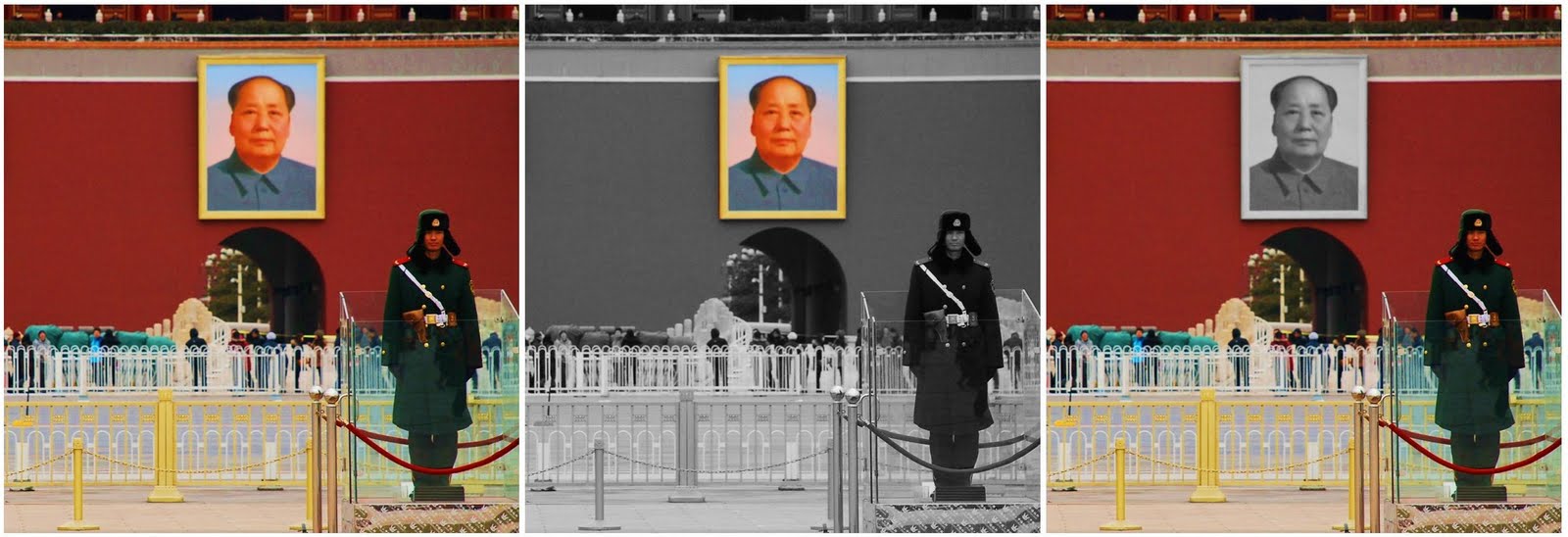 Mao Zedong's giant portrait hung on the 'Gate of Heavenly Peace', the entrance to the Imperial City
So, Tian'anmen Square was the windiest and coldest day for a long while which may have contributed to its underwhelming impact. Not as big as I'd believed, though apparently 4 times bigger than Red Square, it's presided over more by 2 huge screens playing proud Chinese moments (some would say Nationalist propaganda) than Mao's kindly face. It takes some hard thinking to draw up images of the events of 1989 - the famous Tank protest occurred on the incongruously named 'Eternal Peace Street' crossing the north of the square. To the east the National Museum of China, closed for expansion to make it the biggest in the world - nothing's worth having unless it's the biggest. To the west is the Great Hall of the People, from wherein China is ruled by the Communist Party. South lies a huge building housing Mao's preserved body which sees a constant procession of adoring Chinese and curious foreigners, and north is the centre of old Beijing, the Forbidden City.
Like so many places, the grandeur and history of the 600-year-old home of Emperors and Empresses and government past is hard to appreciate or visualise through hoards of shouting, happy snapping, flag following, identically dressed tourists, though it is at least positive to see so many domestic tourists - China's burgeoning as a 'socialist market economy' (or maybe just capitalism without democracy) is a long way from the imagined reality of a 'communist country', and people seem constrained by the more Western ties of money, status and 'success' than state oppression, though that in itself is likely a sign of the State's success in control...
The architecture of the walled city and its nearly 1000 rooms is incredible, but the real interest comes in taking a broader look at the 21st Century city created around it. The old City Walls are now Beijing's busy 2nd Ring Road, punctuated by place names ending in men, meaning gate: sites of the old entrances into the city. The city's hutong (ancient alleyways) - the ones that found enough favour to escape the painting of 拆, meaning 'demolish' - are now bursting with cool independent clothes shops, cafes and bars, some in the old siheyuan courtyard homes dating back 2000 years. These are overlooked by the Drum and Bell Towers which sounded out the time (using a drum and a bell) over the same hutong centuries ago.
The city is nothing like I expected - it's huge and busy but without the chaotic, hemmed-in feeling of Hong Kong. The streets are wide and skyscrapers relatively few so on a sunny morning it feels more like riding through a town than one of the biggest cities on earth. As for China itself, I've only seen 7 of its 22 provinces - 6 from a train window and only a narrow spectrum of Beijing itself - all I do know is just how much I don't know. Spending all my time with a native has opened a lot of doors that would otherwise have remained closed, but in this case more into the life of China's more outgoing and broadminded or Western-born or educated mixed-heritage citizens, rather than gaining any insight into the seething mass of the 1,300,000,000 population. What I've missed out on in true everyday experience has been made up for with fun - snowboarding 45 minutes from the city at Nanshan; ice skating on Beijing's old canal network; drinking with the city's more affluent inhabitants in overpriced boutique bars and dancing to international DJs in the ex-home of a 20th century warlord's government...
Reluctantly that is coming to an end as my visa expires on the 19th - the fastest 30 days of my life - so the next update will be from the hopefully more internet-lenient shores of Japan following a 2 day boat ride from Tianjin. I've met some incredibly lovely, interesting people here and I hope on my next 30 days in the country (date TBA) I can combine that with seeing some more of China's varied landscapes and meeting more of its varied people.
Subscribe to:
Posts (Atom)



